



 Donate
Test your knowledge about Bacterial Blotch (Brown Spot/Brown Blotch)
Evaluate yourself! How well do you know the causes, symptoms, prevention, and treatment principles of bacterial blotch on mushrooms?
Learning resources to pass this quiz: Bacterial brown blotch disease on mushrooms
Shroomok's choice on Amazon
Scientific Labwares High Precision Stain...
Coconut Water Powder HYDRATE ORIGINAL |...
Multi-Grind Automatic Coffee Grinder - W...
Disposable Gloves, Black, 50/100 Pack
Reptile Heating Pad with Temperature Adj...
3-in-1: Autoclavable Grow Bag + Injectio...
black spray paint
Duck Tape, 1.88 Inch x 60 Yard, Silver -...
Professional Humidifier/fogger with Exte...
Airtight Wide Mouth Mason Jars - 8 Label...
Inkbird Temperature + Humidity Controlle...
Bragg Nutritional Yeast Seasoning - 4.5...
Questions covered in this Quiz
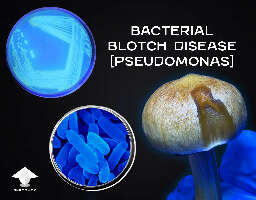
Definition - What is Brown Blotch disease?
Possible answers:
- A bacterial disease that mainly affects mushroom quality / appearance
- A fungal pathogen that turns brown when it sporulates
- A human pathogen that makes mushrooms unsafe to eat and even touch
- A nutrient deficiency that only happens in outdoor grows
Pathogen - Which species of bacteria is most associated with Bacterial Blotch disease on mushrooms?
Possible answers:
- Pseudomonas (especially Pseudomonas tolaasii)
- Bacillus (especially Bacillus subtilis)
- Lactobacillus (especially Lactobacillus plantarum)
- Streptomyces (especially Streptomyces griseus)
Case study - Is there something wrong with the mushroom caps?
Possible answers:
- Bacterial blotch on caps
- Normal caps, just slightly deformed
Practical case - Imagine you noticed signs of bacterial blotch on mushroom caps in your monotub. What are the possible actions?
Possible answers:
- Dry water drops on mushrooms (avoid hard fanning)
- Reduce humidity to 80-85%
- The WD-40 trick to prevent water droplets from the lid from falling on the mushrooms
- Treatment with 150-250 ppm chlorinated water
- Treatment with antibiotic spray
- Wash up mushroom caps with clean filtered water and let them dry
- Maintain a stable humidity of 95-99% to prevent caps from cracking
- Treatment with fungicide spray
Symptoms - What may bacterial blotch look like on the cap surface?
Possible answers:
- Wet, slightly slimy brown spots
- Dry brown speckles and pits
- Fluffy cotton-like growth on mushroom caps
- Dry black spots on mushroom caps
- Ink-like slime on mushroom caps
- Inverted caps, resembling a rose (or gills growing on caps)
Safety concerns - Is it safe to harvest mushrooms with the signs of mild Brown Blotch on their caps / stems?
Possible answers:
- Yes, just dry mushrooms properly (bacterial cells can't thrive without water); toss heavily contaminated (rotted) mushrooms
- No, throw away ALL contaminated mushrooms, even with tiny brown spots
Rough time window & Brown Blotch risk - Blotch risk increases when water stays on caps / stems for…
Possible answers:
- 30 minutes
- 4–8 hours and longer
- Even 2–3 minutes is enough to trigger the brown blotch
- 3 days
Contamination vectors - What do you think are the 2 main vectors for the spread of bacterial spot when growing mushrooms at home?
Possible answers:
- Bulk and Casing substrates
- Air (spores in the air)
- Insects
- Contaminated genetics (spore print, spore syringe or liquid culture)
- Grower (hands, clothes, hair)
- Tools
- Water / humidity (spreading by misting or humidifier)
- Grain spawn
Practical case - What can lead to bacterial blotch?
Possible answers:
- Direct heavy misting onto fruit bodies (especially large droplets)
- Fogger/humidifier running too long without enough fresh air exchange
- Water pools on the substrate surface after misting
- Temperature/humidity swings that increase condensation (including lid drips)
- Using a heat mat under the fruiting chamber
- Intense ventilation / fanning
- Overheating in incubator during bulk colonization perid
- Opening the fruiting chamber too often
Heavy Pseudomonas contamination - What should you do with heavily contaminated mushrooms (more than 50% of the cap is rotten)?
Possible answers:
- Remove and toss heavily affected mushrooms to reduce spread to nearby mushrooms
- Ignore it; blotch always resolves by itself
Treatment - Spot treatments with 150-250 ppm chlorinated water work best when…
Possible answers:
- Mushroom caps are dry (not covered in droplets)
- Caps are visibly dripping wet
- The grow is kept at maximum humidity with constant fogging
- You apply treatment preventatively before any symptoms appear
Condensation control - The article describes a “WD-40 trick” to reduce droplets falling onto mushroom caps from the fruiting chamber lid. What’s the intended effect?
Possible answers:
- Creates a film, that make droplets smaller and more adherent (sticked to the lid) and prevents them from dropping onto mushrooms
- Increase droplet size, so they move to the walls of the fruiting chamber and prevents them from dropping onto mushrooms
- Turn condensation water drops into gel that stays on the lid and and prevents them from dropping onto mushrooms
- Eliminate all humidity from the fruiting chamber and helps to dry out condensation and water drops on mushrooms faster
Case study - What do you think about these mushrooms?
Possible answers:
- Bacterial blotch on caps after drying
- Normal caps with cracks due to low humidity environment
Case study - Bacterial blotch?
Possible answers:
- Yes, it's bacterial blotch on cap
- No, it's mutation (rosecomb)
Case study - "First timer. Hillbilly strain." Are the caps (in blue circles) fine?
Possible answers:
- Absolutely fine, just a genetic feature (phenotype)
- It's mild bacterial blotch on caps
Read this article Bacterial brown blotch disease on mushrooms to pass Quiz successfully