



 Donate
Test your knowledge about Mucor & Rhizopus (aka Black Pin Mold or Bread Pin Mold)
I hope you carefully read the article on Black Pin mold contamination. To strengthen your knowledge, let's take a test
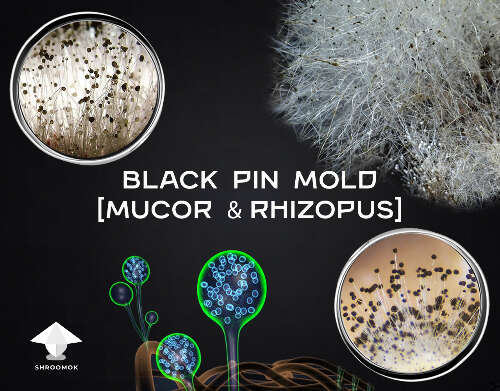
Learning resources to pass this quiz: Black Pin Mold (Rhizopus & Mucor)
Shroomok's choice on Amazon
Portable Humidifying Unit - 0.7 L - Ligh...
Coconut Water Powder HYDRATE ORIGINAL |...
Organic Coconut Coir Brick, 5/10/15/20 B...
Soil pH Paper Testing Kit, 3.5-9 Range,...
Shannon's Sawmill's Mixed Hardwood SAWDU...
Laboratory-Grade Calcium Hydroxide 500g
UV Light Bulb with Base - Ozone, with Ti...
Pasteurized Casing Mix
Mushroom Supplies, Grow Kit in-a-Bag, Al...
Magnesium Complex Supplement Capsules 50...
Hard Red Winter Wheat Berries, 5 lbs
10 Gloves and 1 Mask Bundle
Questions covered in this Quiz
Black Pin Mold case study - Imagine that you've found unusual fluffy spiky mycelium growth on your cake (without any signs of color). How to know whether it's early signs of pin mold or mushroom mycelium? What would you do?
Possible answers:
- I'd wait if I'm not sure. If it's mold, the spiky fluffy area will double in size within the next 4-6 hours. If it stays the same size, then it's just mycelium
- I'd swipe the area with cotton swab (Q-tip test). If any color on the swab - it's mold. If it's clean - mycelium
- Mushroom mycelium is never fluffy, so I would start treatment right away
- I'd toss it immediately as it is a toxic pathogen
- I'd post the photo(s) on the forum, and Shroomok would help me with the identification
The difference between Black Pin Mold mycelium and mushroom mycelium - What is the difference between EARLY pin mold mycelium and mushroom mycelium?
Possible answers:
- There is no difference between early Pin Mold mycelium and mushroom mycelium. You can only see the difference on the late (sporulating) stage
- Pin mold mycelium is thinner compared to mushroom mycelium
- Pin mold mycelium is thicker compared to mushroom mycelium
- Pin mold has bright white color compared to dull mushroom mycelium
- Pin mold has slightly graish color compared to snow-white mushroom mycelium
- Pin mold has spiky, "cat hair"-like growth compared to flat mushroom mycelium
- Pin mold has flat rope-like growth, while mushroom mycelium has cobweb-like growth
Mucor & Rhizopus treatment for mushroom cake - What would you do if you find signs of pin mold (without black pins) on mushroom cake?
Possible answers:
- I'd toss the contaminated cake. Once there are any signs of Mucor or Rhizopus, the cake can't be saved
- I'd cut off the contaminated area, as it has not yet released spores
- I'd spray hydrogen peroxide H2O2 3% on contaminated area and around it (3 times every 12 hours)
- I'd soak paper towel in hydrogen peroxide H2O2 3% and put it on the contaminated area. Then I'd spray that area again 2 times more (12 hours break between treatments)
Pin mold treatment for grain spawn - What would you do if you find signs of Pin Mold in grain spawn jar?
Possible answers:
- I'd toss the contaminated jar. Once there are any signs of mold in grain, the jar can't be treated and used for the next steps
- I'd open the jar and cut off the contaminated area
- I'd spray hydrogen peroxide H2O2 3% on contaminated area and around it (3 times every 12 hours)
- I'd soak paper towel in hydrogen peroxide H2O2 3% and put it on the contaminated area
Pin Mold speed of spores formation - After noticing signs of Mucor or Rhizopus growth, black spores typically appear within the next
Possible answers:
- 2-3 hours
- 12-24 hours
- 1-2 days
- 2-3 days
Heat treatment for bulk substrate in order to prevent Mucor & Rhizopus mold - What are possible effective heat treatment(s) in order to prevent Mucor & Rhizopus spores in BULK substrate?
Possible answers:
- Pasteurization at 105-120°F or 40-50°C for 1+ hour(s) will destroy all mold spores
- Pasteurization at 140-160°F or 60-70°C and higher for 1+ hour(s) will destroy all mold spores
- Pasteurization is not effective, only sterilization in pressure cooker at 250°F or 121°C for 1,5 hours will destroy all mold spores
- Sterilization in pressure cooker at 212-250°F or 100-121°C for 1 hour will destroy all mold spores
- Neither pasteurization nor sterilization are effective, since Black Pin Mold spreads primarily through the air, not through the substrate
Proper use of hydrogen peroxide H2O2 for the treatment of Mucor & Rhizopus - Why is it NOT recommended spraying the contaminated area with hydrogen peroxide H2O2, if Mucor or Rhizopus mold spores are already visible?
Possible answers:
- Because spraying doesn't create thick layer of H2O2 for effective treatment
- Because intense spraying creates air movement and spreads mold spores throughout the cake. It is better to use H2O2 application instead –paper towel soaked in H2O2
- Because H2O2 is absolutely ineffective against mold spores
Read this article Black Pin Mold (Rhizopus & Mucor) to pass Quiz successfully