



 Donate
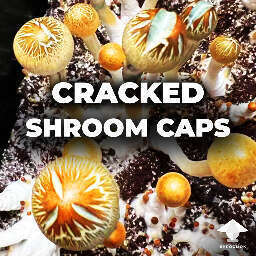
Test your knowledge about Mushroom Cap Splitting & Cracking
Evaluate yourself! Diagnose why caps crack, what it does (and doesn’t) mean, and what cultivation parameters to adjust.
Learning resources to pass this quiz: Mushroom caps splitting and cracking issue
Shroomok's choice on Amazon
Coreel Portable CO2 Monitor + Temperatur...
Potato Flakes
BetterFungi 3 Lb Sterilized Grain Bag wi...
Thermostat
Stranded Copper Wire 16 AWG 10 ft
Life Extension Magnesium Caps, 500 mg, M...
pH Test Paper 1 to 14 for water, soil, b...
Proper Pour - Clear Vinyl Plastic Tubing...
Digital 4-in-1 Soil Test Meter
Isopropyl Alcohol 70% - 1 gallon & a 32...
Sterile Water 100ml 6 Bottles
Stainless Steel Mason Jar Lids and Rings...
Questions covered in this Quiz
Mushrooms content - Mushrooms are mostly…
Possible answers:
- Water (around ~90%)
- Protein (around ~90%)
- Fat (around ~90%)
- Fiber (around ~90%)
The main cause of cracking caps - The most common underlying cause of cap cracking is…
Possible answers:
- Dehydration from low / unstable humidity around the fruit bodies
- Too much light during fruiting
- Using grain spawn after storing in refrigerator
- Cold-shocking or soaking mushroom cake in cold water
Humidity level and cracking risk - Cracking risk increases when relative humidity drops below about…
Possible answers:
- 60%
- 85%
- 95%
- Humidity doesn’t matter
Actions that contribute to cracking - Which actions contribute to cracking?
Possible answers:
- Aggressive fanning
- Very active fresh air exchange (FAE) without balancing humidity
- Using a closed fruiting chamber
- Gentle passive air exchange
How to fix cracked caps - Which “fix” is the most accurate once caps have already cracked?
Possible answers:
- You can’t reverse cracks on existing mushrooms; focus on preventing it in future flushes
- Spray water directly onto cracked caps to “heal” them
- Cut out the cracked area and it will heal
- Add more nutrients to the substrate
Best practice - How should water be misted to maintain humidity in the fruiting chamber?
Possible answers:
- Use a fine mist and target tub walls / airspace; avoid spraying mushrooms directly
- Always spray mushrooms directly until they glisten
- Only mist once, at pinning, then never again
- Mist only the lid so water can drip onto caps
FAE - What type of fresh air exchange (FAE) is recommended to reduce CO₂ without drying things out?
Possible answers:
- Passive FAE (air vents or small gaps), avoiding vigorous fanning
- Strong fanning as often as possible
- No air exchange at all during fruiting
- Opening the chamber and leaving it uncovered for a few minutes
"Healthy" cracks vs Contamination - When should you suspect “something else” (possibly contamination) rather than simple cracking?
Possible answers:
- If cracking comes with abnormal colors (yellow, brown, gray, black), spotting, necrosis, or major deformations
- Any crack is automatically contamination
- Only if stems get taller
- Only if stems crack but caps do not
Non-environmental causes of cracking - Apart from the environment, what other main causes of cracking are mentioned in the article?
Possible answers:
- Genetic factors / mutations (some triggered by environmental changes; some present from the start)
- Using tap chlorinated water for misting or rehydration always causes genetic changes and cracking
- Bacterial pathogens like Bacterial Blotch disease (especially after treatment)
- Mold contamination on mushrooms cause cracking
Case study - What do you think is the cause of the cracked mushroom cap (in the center)?
Possible answers:
- Genetics / mutation
- Excessive FAE and low humidity
- Contamination
- Bruising
Case study - What is the cause of the radial cracks on mushroom caps here?
Possible answers:
- Environmental issue (lack of moisture and / or excessive fanning)
- Contamination issue (caps after bacterial blotch disease treatment)
Case study - What is the cause of the cracked mushroom caps in this case?
Possible answers:
- Environmental issue (lack of moisture and / or excessive fanning)
- Contamination issue (bacterial blotch disease)
Read this article Mushroom caps splitting and cracking issue to pass Quiz successfully