



 Donate
Test your knowledge about Blue‑Green Mold (Penicillium) Contamination
Learn how to recognize Penicillium in mushroom cultivation, distinguish it from bruising and other green molds, and respond appropriately.
Learning resources to pass this quiz: Blue-Green Mold Penicillium Contamination in Mushroom Cultivation
Shroomok's choice on Amazon
Organic Garden Lime Calcium Carbonate, 5...
Professional Food Dehydrator Machine
Isopropyl Alcohol 70% Spray 32 oz or big...
(1LB) Organic Coconut Activated Charcoal...
Large Storage Bin, 132 Qt, 1 Pack
https://amzn.to/3IZfG6f
Food Coloring Set
Soil pH Test Strips Kit (3.5-9 Range) 10...
Pasteurized Mushroom Substrate - Cow Man...
Durable Food Container Sets with Lids -...
Bodaon Insulated Pizza Delivery Bags, 20...
Middle Mushroom Spawn Bags with Filter -...
Questions covered in this Quiz
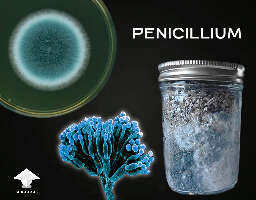
Definition of Penicillium - What is Penicillium (in general terms)?
Possible answers:
- A common airborne mold genus with many species, found indoors/outdoors
- A mushroom species that only grows on grain
- A type of bacterial blotch disease
- A harmless bruising reaction in mycelium
Visual ID of molds - Why is “visual ID only” not reliable for green molds?
Possible answers:
- Several molds can appear green (e.g., Penicillium, Trichoderma, Aspergillus etc.), so microscopy is needed for certainty
- Green color always means Penicillium
- Healthy mycelium routinely turns blue-green when mature
- Green color only appears on fruits and vegetables, not on mushroom substrate
Mold vs Bruising - What do you see in the photo?
Possible answers:
- Mycelium bruising
- Mold contamination
Color development - Penicillium often starts as...
Possible answers:
- Bright white growth that later turns green/blue‑green/green‑grayish/yellow
- Green powder from day one
- Blue-green growth from day one
- Blue growth on the substrate
Growth pattern - Penicillium commonly forms…
Possible answers:
- Circular/oval patches that expand outward in a fairly uniform ring
- Long rope-like rhizomorphs that radiate in straight lines
- Random isolated pinpoints with no expansion
- Only bottom-up growth that starts underneath the substrate
Growth speed - How long does Penicillium often take to go from white to green/blue‑green?
Possible answers:
- 1–2 hours
- ~2–3 days
- ~5–7 days
- It never changes color
Penicillium vs Trichoderma - Compared to Trichoderma, Penicillium can turn green…
Possible answers:
- Much faster, within ~2–4 hours
- Much slower, usually 2-3 days
- At the same speed, within 12 hours
- Only if sprayed with peroxide
Penicillium texture - Early Penicillium contamination is often described as…
Possible answers:
- Lumpy/bumpy, sometimes compared to “curdled milk”
- Smooth, glossy, and transparent
- Thin grey wisps like smoke
- Cobweb-like growth
Penicillium maturation - Mature Penicillium is often…
Possible answers:
- Powdery (spore-producing)
- Completely liquid
- Always slimy and wet
- Identical in texture to bruised mycelium
The most preferred spots of Penicillium - Where does Penicillium tend to prefer growing on a cake/block?
Possible answers:
- Mostly on the surface where oxygen is highest (usually not deep inside)
- Mostly deep inside the substrate
- Mostly on the underside/bottom of the block
- Mostly on mushroom fruit bodies
Bruising vs Mold - Which statements are most accurate?
Possible answers:
- Bruising is color change within the mycelium tissue and is NOT powdery
- Bruising always produces green powder
- Mold is always blue, bruising is always green
- Mold often becomes powdery when sporulating
Q‑tip test - What result suggests mold spores rather than bruising?
Possible answers:
- Powder transfers onto the white swab after gently wiping the suspicious area
- The swab stays clean and white
- The swab smells like mushrooms
- The swab turns blue after touching any mycelium
Penicillium contam in grain spawn - Can you “save” grain spawn once Penicillium has turned green/blue‑green/yellow?
Possible answers:
- No, once it’s colored, it’s sporulating; toss the jar/bag
- Yes, cut the colored area out and use the rest
- Yes, open the jar and make a salt application
- Yes, open the jar and spray it with hydrogen peroxide
Early-stage treatment - Before visible color of Penicillium appears, you may try…
Possible answers:
- Salt or baking soda to cover/seal the small early patch
- Hydrogen peroxide applied to a paper towel placed on the spot (rather than blasting spores by spraying)
- Scraping the patch aggressively to remove it
- Leaving it alone until it turns green so it’s “easier to identify”
Practical case - What do you see in the photo?
Possible answers:
- Early Penicillium mold
- Just mushroom mycelium
- White mushroom mycelium with light bruising
Penicillium on agar - If you must rescue genetics from a mold-contaminated agar culture, what is a possible cleanup path?
Possible answers:
- Isolating clean mycelium via repeated transfers on agar until it’s clean
- Using antibiotics, so the mycelium outgrows the mold instantly
- Freezing the culture to kill mold spores
- Spraying hydrogen peroxide into the agar plate
Practical case - What do you see in the photo
Possible answers:
- Early bright white mold contamination that turning blue-green
- Mycelium bruising
- Nothing strange, just mycelium growth
Case study - Is it possible to treat this contaminated cake?
Possible answers:
- No, it's too late
- Yes, I'd apply salt on the contaminated areas
- Yes, I'd spray with hydrogen peroxide
- Yes, I'd make hydrogen peroxide application
Practical case - What do you see in this grain spawn jar?
Possible answers:
- Blue-green mold contamination
- Mycelium bruising
Case study - What’s the result of this Q-tip test?
Possible answers:
- Mold contamination
- Bruising
- It's fine – neither mold nor bruising
Read this article Blue-Green Mold Penicillium Contamination in Mushroom Cultivation to pass Quiz successfully