



 Donate
Test your knowledge about Mycelium Metabolites aka Mushroom Piss
It's time to pass a quick test! Learn to recognize normal metabolites, understand what causes them, and tell them apart from contamination.
Learning resources to pass this quiz: Mycelium metabolites or mushroom pee
Shroomok's choice on Amazon
Premium Stylish Food Dehydrator - Stainl...
Dextrose
Viddie's Bakery Ultra Fine Brown Rice Fl...
Stranded Copper Wire 16 AWG 10 ft
STC-1000 AC 110V Temperature Heating/Coo...
Inkbird Temperature + Humidity Controlle...
Ball Wide Mouth Mason Jars with Lids & B...
Reusable Lunch Boxes with Lids, BPA Free...
Desk Gooseneck Magnifier Lamp - Metal La...
Pasteurized Mushroom Substrate - Cow Man...
Mason Jars Wide Mouth with Lids, 32oz -...
pH Test Strips 0 to 14 for Water & Liqui...
Questions covered in this Quiz
Definition of Metabolites - Mycelium metabolites (aka mushroom pee) are…
Possible answers:
- Mycelium waste products, often linked to stress or immune response
- Always a sign of lethal contamination that must be discarded immediately
- A kind of "mushroom juice” produced during fruiting only
- A fertilizer that the mycelium produces to feed itself
Case study - What do you see in this grain bag (yellow circle)?
Possible answers:
- Metabolites
- Bacterial contamination (wet rot)
- Yellow mold contamination
- Wet bubble disease (Mycogone) contamination
Signs of metabolites - Which is a typical sign of metabolites (the “healthy” look)?
Possible answers:
- Yellow / orange / brown liquid
- Cloudy liquid
- Earthy / mushroom smell or NO smell at all
- Sweet-sour smell
- Transparent liquid
- Slimy liquid
- Rotten smell
- Amber or brown liquid
NOT metabolites - Which feature most strongly suggests it’s NOT simple metabolites?
Possible answers:
- Clear yellow droplets with no slime
- Slimy liquid and strong fermented / rotted / sour smells
- Light beige mycelium pigmentation without odor
- A small amount of amber liquid on otherwise healthy growth
Causes of metabolites - Which are listed as common “stressors” that can trigger metabolite exudate?
Possible answers:
- Over-misting / water pools on the mycelium
- High temperature
- Cold shocking
- Direct sunlight
- Mild contamination
- Soaking mushroom cake in water
Pigmentation / Metabolites in grain spawn - Which colonization factors are a possible causes of pigmentation/metabolites in grain spawn?
Possible answers:
- Aged mycelium / old spawn jars/bags
- Spawn overheating in incubator
- Metabolites often appear after "Break & Shake"
- Only the choice of grain (and nothing else)
- Fighting with mild bacterial contamination
- Cold shocking or after storing spawn in refrigerator
Sectoring - The article mentions “sectoring”: what does the yellow-brown boundary line often represent?
Possible answers:
- A boundary where different colonies / pathogens compete
- A “nutrient stripe” that improves yields
- A sign of overhydrated substrate
- A sign of dehydrated substrate
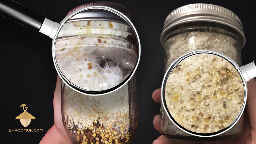
Practical case - What do you see in the spawn jars?
Possible answers:
- Pigmentation / metabolites
- Bacterial contamination
- Yellow mold contamination
- Nothing wrong, this is what normal mycelium looks like
Case study - Small yellow drops appeared in spawn jar. What is this?
Possible answers:
- Wet bubble (Mycogone)
- Metabolites
- Bacterial (wet rot) contamination
- Condensation water drops
Metabolites vs look-alike pathogens - Which “look-alike” is described as easy to identify by slime + strong off smells?
Possible answers:
- Bacterial (or yeast) contamination
- Overlay
- Yellow mold contamination
- Wet bubble (Mycogone) contamination
Metabolites vs Mycogone - Wet Bubble disease (Mycogone) can be confused with metabolites because…
Possible answers:
- It can ooze amber liquid, but typically with rotten smell and abnormal blobs / pins / clots
- It produces green powdery spores on the surface
- It only appears as dry white fuzz with no liquid
- It only affects harvested mushrooms
Metabolites vs Yellow Mold - “Yellow mold” is differentiated from metabolites because…
Possible answers:
- It has a yellow powdery texture without liquid (unlike droplets / exudate)
- It produces clear yellow droplets with no powder
- It always smells like coconut
- It only appears in grain spawn jars/bags and never appears on cake
Metabolites & surface conditions - Metabolites often appear together with what kind of surface condition mentioned in the guide?
Possible answers:
- Overlay
- Dry bubble disease
- Cobweb mold
- Any mild contamination (bacterial or fungal)
Practical response - If metabolites appear in a “low pool” area, what is the key principle?
Possible answers:
- Avoid spraying water on mycelium directly. If this happens, let it dry naturally
- Add more water to dilute the metabolites and dry out with fan as fast as possible
- Seal the container airtight to lock in humidity
- Scrape the mycelium to remove the liquid
- Avoid water pooling; manage excessive moisture gently by natural drying or using a paper towel so the surface isn’t sitting wet for long periods
- Avoid water drops from the lid to fall on the mycelium
Case study - What do you see in this spawn jar?
Possible answers:
- Metabolites
- Bacterial contamination
Case study - First time growing Natalensis (CVG substrate). What is the yellowish discoloration on mycelium?
Possible answers:
- Pigmentation, kind of metabolites
- Yellow mold contamination
- Bacterial contamination
- Wet bubble disease
Case study - What is this yellowish discoloration in the grain spawn bag?
Possible answers:
- Metabolites
- Yellow mold contamination
- Bacterial contamination
- Wet bubble disease
Case study - Try to identify the issue and suggest what to do in this case: "Contamination or not? Also the liquid is what really concerns me. I don't feel any smell. Considering putting a paper towel and draining the pooling."
Possible answers:
- Metabolites & hyper white mycelium blob / clot is early green mold (will turn green in a few days)
- Wet bubble disease – blob / clot with coral-like dents that ooze a cloudy liquid
- Cloudy brown liquid – bacterial (wet rot) contamination on mycelium and just mycelium blob / clot
- Just metabolites with water pools and fluffy mycelium blobs / clots
- I'd quarantine it for 1-3 days to see changes
- Toss the cake, it's impossible to save it
- Yes, paper towel is a good approach
- Just leave it as is, don't mist the mycelium and let the liquid to dry slowly
Case study - Yellow-brown drops on mushroom mycelium. What is this?
Possible answers:
- Mycelium metabolites
- Bacterial contamination
- Wet bubble disease
Read this article Mycelium metabolites or mushroom pee to pass Quiz successfully