



 Donate
What the long stems, fuzzy feet and fuzzy caps indicate
Okay, grower! You’re enjoying your own cultivation process, and suddenly notice your mushrooms are starting to grow a fuzzy stem, become leggy with small caps or strange fluffy white dots appear on the mushroom caps. Why this happen?
What is this fuzzy stuff? Is it contamination? What's wrong with such mushrooms? Is it possible to fix?
Lots of questions, so let’s get started!
First of all, it's not contamination! All these cases have the same main reason – lack of oxygen, lack of fresh air exchange (FAE) in fruiting chamber during fruiting period.
Leggy mushrooms – long stems and small caps
Mushrooms and mycelium breath like humans. They inhale oxygen (O2) and exhale carbon dioxide (CO2).
When oxygen level is too low, fruit bodies grow long stems to search for fresh air. As a result mushrooms have small caps and spindly stems.

You may think, “Oh, my mushrooms are so big! That’s cool!” However, the mushroom tissue inside the stem can be airy and spongy. It’s not a big problem for P. cubensis (though it can affect potency), but it is a real problem for edible mushrooms — they become tasteless with poor texture, literally like a sponge.
Fuzzy feet
In fact, fuzzy feet are mushroom mycelium! It isn’t a major problem, and it’s not a contamination issue.


Such fuzziness is typically caused by two growing factors.
Lack of fresh air exchange (FAE) in fruiting chamber.
As we know, CO2 is heavier than oxygen and concentration is higher at the bottom of the tube and lower as we go up to air vents and lid of fruiting chamber. So that, the base of our shrooms will be the first area struggling to breathe.High relative humidity level combined with a lack of FAE.
Sounds strange, doesn’t it? We know that mushrooms enjoy high humidity! That’s true. However, in this case, high relative humidity affects the gas balance in the fruiting chamber. When we increase humidity and add excess moisture, we reduce the amount of free air space available for oxygen. As a result, the mushrooms begin to suffocate, which leads to fuzzy feet.

White dots or fuzzy mushroom caps
One more example usually confused with mold contamination or mutation. But the reason is poor FAE again.

Let me show you another more bright case.

– Angelinejovan: Contamination? Fuzzy caps! What the hell is this!?
– Shroomok: Looks ok so far, don't worry. It's just mycelium, not contam! Your shrooms need more fresh air, that's why fuzzy. Try to FAE 4-6 times/day for the next 2 days.
– Angelinejovan: Thank you for all your help! What a difference a day makes. Yesterday they were fuzzy, then after fanning every four hours religiously overnight the fuzzies have stopped growing. And I’ve been able to harvest over 7 ounces today. I am so ecstatic!! (BTW the fuzzies peel off the caps & stems).
How to fix fuzzy feet, fuzzy caps and leggy mushrooms
Unfortunately, once mushrooms become leggy, it can’t be reversed — but you can fix the issue for the next flush.
Fuzzy feet and caps? No problem. Try introducing more fresh air for your mushrooms. Usually, you can fix this easily within 1–3 days.
Manual FAE. Open your fruiting chamber for 3-5 minutes at least 4-6 times/day.
Natural airflow in MonoTub. Properly made air vents in MonoTub create light natural airflow.
If air vents made wrong you have "dead zones" in the corners of your tub and poor overall FAE.
🔴 Recommended: Monotub Guide
You can use additional gadgets in fruiting chamber.
– For FAE (fresh air exchange):
1) aquarium air pump for light constant FAE
2) or install small PC fan as exhaust fan. Use minimum air flow just for 2-3 mins in combination with misting after fanning
3) or combination of PC fan + humidifier
Shroomok's choice on Amazon:
Air Pump - $19.97
PC Fan with power plug - $18.99
Humidifier 3L - $49.99
– CO2 detector to monitor carbon dioxide concentration. Ideally to have 600-800 ppm (up to 1500 ppm for P. Cubensis) of CO2 in fruiting chamber.
Shroomok's choice on Amazon:
INKBIRDPLUS Air Quality Monitor: CO2, Temp., Humidity for Grow Tents - $79.99
Fuzziness vs. Contamination – how to tell them apart
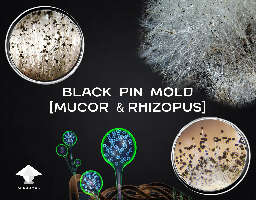
Very often, newbie growers confuse fuzziness on stems and white dots on caps with Cobweb Mold or Black Pin Mold (Mucor and Rhizopus) contamination, which can cover mushroom pins.
It's quite easy to distinguish fuzzy feet, cobweb mold and black pin mold disease.
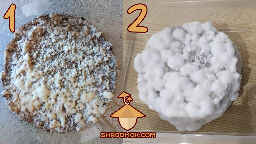
Just remember: Cobweb Mold and Black Pin Mold have thinner mycelial threads and a grayish color compared to snow-white mushroom mycelium!
Let’s take a look and compare!
Here is a case of healthy fuzzy feet:

This is Cobweb Mold contamination on mushroom cake:

🔴 More examples: How to identify and get rid of Cobweb Mold
Another case is Black Pin Mold. At an early stage, it forms white to grayish, spiky mycelium. Later on, you can notice tiny black beads:

🔴 More examples: Black Pin Mold (Mucor and Rhizopus)
Wrap it Up!
Mushrooms interact with us and always give clear signals about what they need. Long stems, fuzzy feet, and fluffy caps mean your mushrooms are begging for a breath of fresh air.
Learn the mushroom language, grower!
If you find this guide helpful, please consider supporting me 🍄 Buy Shroomok a mushroom as a donation and say something nice!
You can also get help for free on Forum, leave a comment below or request a Personal consultation.
Be attentive to your shroom pets, and happy growing!
Comments
Can you dry your shrooms with fluffy stems and consume it? Or do you need to scrape it off before you dry them?
@Joyshroom in fact fluffy stems is just mushroom mycelium. It's totally safe! No need to scrape it off
Thanks so much for this article, it's saved me from throwing away a potentially great grow as I was worried about it being contaminate.
I'll be introducing a lot more fresh air exchange now, and hopefully fix the issue.
@Ash, glad I could be of assistance. Have a happy growing!
Add comment